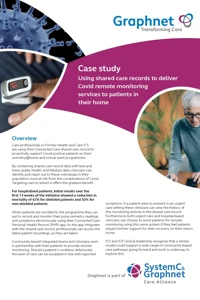
How Graphnet’s CIPHA Platform Supported COVID-19 Response and Population Health Management
18 June 2021
At a Glance:
- Client: Cheshire and Merseyside NHS
- Technology: Graphnet’s CIPHA population health platform
- Location: Across England
- Key results: Supported Cheshire and Merseyside’s COVID-19 response, including mass testing and vaccine delivery, and now supports population health management across England, reaching more than 17 million people.
Find out how the Combined Intelligence for Population Health Action (CIPHA) helped NHS organisations, local authorities and social care providers use health and care data to identify population needs, target interventions and plan more effective services.
Developed in Cheshire and Merseyside during the COVID-19 pandemic, CIPHA combines local and national feeds, including Pillar 2 community testing data and National Immunisation Management System (NIMS) data, and makes it available in the Graphnet Population Health platform.
This provides real-time intelligence to support crisis management and recovery, enabling prompt co-ordinated actions at the local level and across Integrated Care Systems.
Since its initiation in 2020, CIPHA has expanded across England to support a population of more than 17 million people.
The Challenge
During the COVID-19 pandemic, health and care organisations across Cheshire and Merseyside needed a clearer, timelier picture of local health needs and pressures.
Two COVID-19 resilience cells identified the need for a real-time analytics platform that could bring together information held across multiple organisations and datasets.
This would help decision makers monitor the spread of COVID-19, understand changing demand and coordinate an effective response and recovery.
The Solution
Graphnet’s Population Health platform provided the technology behind CIPHA, bringing together local and national datasets and making them accessible through analytics, dashboards and reports.
The platform combined information including community COVID-19 testing and immunisation data. Its dashboards initially focused on three areas:
- Capacity and demand
- Epidemiology
- Population stratification
This gave organisations a more joined-up view of population health, helping them coordinate decisions across organisational boundaries.
The Results
CIPHA was rolled out across Cheshire and Merseyside, becoming a central part of the region’s COVID-19 response and subsequent recovery.
Within just three months, the original programme went live across 40 organisations and 359 GP practices. It provided dashboards to support operational decision-making, alongside nearly 100 reports for more than 1,000 users across the system.
CIPHA also played a key role in mass testing, vaccine delivery and national investigations into reopening events during the pandemic. Its applications continue to support the region’s recovery, including through virtual ward programmes.
The programme has since expanded beyond its original region and is being extended elsewhere across England. Today, CIPHA covers a population of more than 17 million people, supporting health and care systems in developing and sharing new approaches to coordinated, data-led care.
Practical Use Cases for CIPHA Today
The programme has enabled health and care systems to develop and share practical use cases beyond the original pandemic response, including:
- Patient treatment list stratification using population data to help manage waiting lists
- Pulse oximetry and Personal Health Records (PHRs)
- Virtual wards to optimise the management of long-term conditions, such as blood pressure monitoring in hypertensive patients
Other use cases identified as priorities by member organisations include complex care (multi-morbidity), cancer, suicide prevention and early intervention.
The Future of CIPHA
CIPHA is continuing to evolve beyond its original role in the COVID-19 response, with the ambition of accelerating health and care transformation and developing new care pathways.
It supports Integrated Care Systems by providing access to datasets and helping them develop the technical capabilities needed for more mature population health analytics.
Its linked, system-wide data also provides a trusted research environment for developing analytics to support national research projects.
Turn Population Health Intelligence into Action
Discover how Graphnet’s population health management solutions can help your organisation identify people who need support, target interventions and plan more proactive care, or contact Graphnet to discuss your requirements.



Population Health in Practice | Digital Health Rewired
How the CIPHA programme used actionable intelligence to understand the region’s pressures and deliver targeted care